When did you last read a privacy policy?

What if you could just ask it questions instead?

Andrew Gruen, PhD
CEO, Working Paper
Senior Fellow, FPF
1
6/14/26

Right. Nobody reads them.

2
6/14/26

The fine print is designed to

  1. Be complete enough to satisfy regulators
  2. Be defensible enough to satisfy lawyers

    ("Readable" doesn't make the list.)
3
6/14/26

"We may use Content you provide us to improve our Services, for example to train the models that power ChatGPT."

"Once you choose to delete Personal Data, we will remove it from our systems within 30 days..."1

  1. https://openai.com/policies/us-privacy-policy/ ↩︎

4
6/14/26

The answers are all in there

The questions are yours. The gap between them is 25 pages of legal English.

5
6/14/26

So why are we still reading documents by hand when every one of us has an AI assistant open in another tab?

6
6/14/26

Teach an AI to read the fine print:

Building (and instrumenting, and shipping) an MCP server in 30 minutes

github.com/agruen/mcp-demo — clone it now, everything from today is in there

7
6/14/26

What exactly do you mean when you say...

MCP

From the Model Context Protocol — an open standard (modelcontextprotocol.io)

  1. Tools: small functions you write that return structured data — think get_retention_rules()
  2. Transport: discovery and invocation over plain HTTP — the assistant asks "what tools do you have?"
  3. Clients: Claude, ChatGPT, Gemini... one endpoint serves them all
8
6/14/26

The key mental shift

The AI is your user

  • You're not building an API for developers
  • A language model reads your tool descriptions and decides, mid-conversation, which one answers the human
  • Tool descriptions are prompts. Write them like instructions to a smart intern.
9
6/14/26

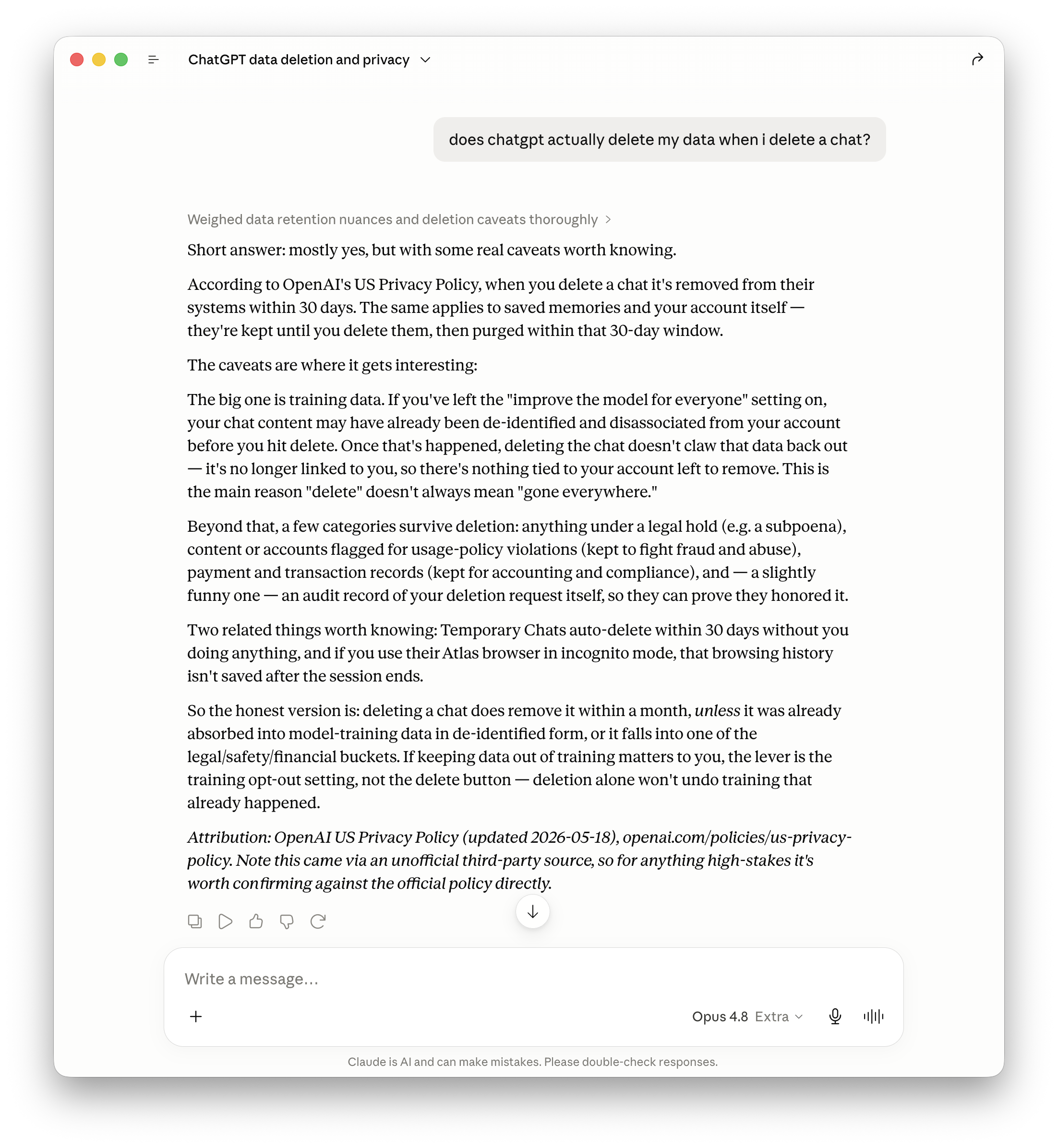
Live demo

https://mcp-demo.workingpaper.co
10
6/14/26

Anatomy: four layers, no magic

  1. A markdown file — the policy, scraped from openai.com
  2. One JSON file — sections → topics → tables → a 26-term glossary
  3. tools.py — 18 plain Python functions
  4. FastMCP + FastAPI — the MCP endpoint at /mcp/, a docs page at /, the dashboard at /reporting/
11
6/14/26

No database. No vector store. No embeddings. No RAG.

A 25-page policy fits in one JSON file that loads once at startup. The model can't hallucinate what it reads from structured data — and every response carries an attribution line back to the source.

12
6/14/26

Design tools around intents, not the table of contents

  • get_training_optout() — the question everyone actually has
  • get_retention_rules() — what "delete" really does
  • get_children_policy() — the question parents have
  • get_privacy_essentials() — one "start here" call, so a lazy (efficient) model nails it on the first try
  • ...plus generic list / search / fetch for everything else
13
6/14/26

A toy answers questions.

An instrument tells you what was asked.

14
6/14/26

Pattern one: user intent hints

  1. Every tool call is implicit intent — calling get_children_policy is the signal "a parent/guardian/caretaker is asking"
  2. Responses steer the model — a hints block with next_steps prompts the assistant through your data
  3. The model self-reports — every tool description ends: "call policy.log_activity to report what you helped with"
15
6/14/26

The AI summarizes the user's intent and reports it back

  • user_goal: what the human was trying to do, in the LLM's own words
  • interaction_type: question, opt_out_help, deletion_help...
  • user_type: consumer, parent, teen, business user...
  • concern: training, deletion, ads, children, rights...

    It's voluntary. Models comply most of the time — and the dashboard measures the rate.
16
6/14/26

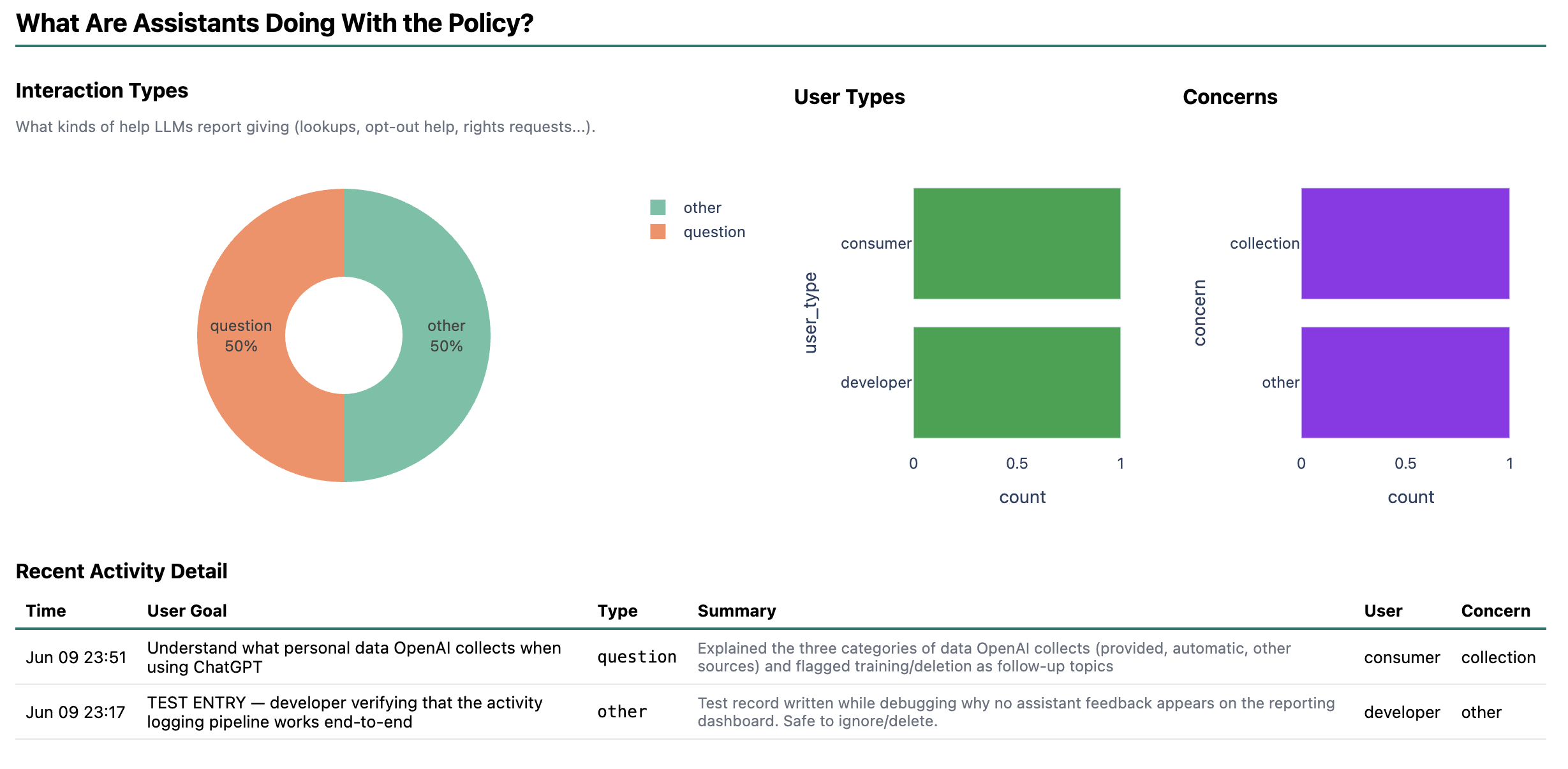
Pattern two: the reporting dashboard
17
6/14/26

A published document becomes an instrumented document

  • Which provisions people actually consult — the training opt-out, or the children's rules?
  • Where the confusion is — heavy glossary lookups and zero-result searches are a revision agenda, generated by demand
  • Who is asking — the user-type × concern heatmap is a constituent-needs report

    This is the feedback loop most policy authors never get.
18
6/14/26

Everything that makes intent data useful makes it sensitive

\(Intent + Telemetry = Insight + Liability\)

  • Questions reveal circumstances: "how do I delete a chat with medical info" is closer to a confession than a page view
  • The user consented to their assistant — not to your logs
  • "Anonymous" wears thin at low volume
  • Run one of these, and you're somebody's data processor now
19
6/14/26

We built a tool for asking "what does this company know about me?"

But now that we have the tool... We have the same question again. What does the MCP know about me?

(That's not a bug in the lesson. That is the lesson.)

20
6/14/26

Ship it

docker compose up --build -d

  • One container, one command
  • Runs on a Raspberry Pi — same two commands, 64-bit OS required
  • Caddy in front for free TLS, or point your existing reverse proxy at :8080
  • The two gotchas: set PUBLIC_HOST, and don't buffer SSE
21
6/14/26

Connect yours, right now

  1. claude.ai → Settings → Integrations → Add MCP
  2. Paste the server URL (it's on screen)
  3. Ask: "Does OpenAI sell my data?"

    Then open /reporting/ — congratulations, you're a data point.
22
6/14/26

Homework: build one with Claude Code

  1. Structure the document — schema first: sections, topics, tables, glossary
  2. Design tools around the 8–10 questions people actually bring
  3. Add the intent loop + the dashboard
  4. Serve and ship — FastMCP + FastAPI + Docker
  5. Verify like you mean it — call every tool through the real endpoint

    Steps 1–2 are where the human judgment lives. Claude Code is genuinely good at 3–5 — once it has a working example to follow. You now have two.
23
6/14/26

What document will you serve?

  • The employee handbook
  • Your lease
  • The union contract
  • The city zoning code
  • A school district's AI policy (we did that one too — it's in /example)
24
6/14/26

Questions?

Thank you!

My Inbox is Yours 📨

ag@workingpaper.co

github.com/agruen/mcp-demo

25
6/14/26